SUB-THEME: THE CONSOLE WARS — SEGA VS. NINTENDO VS. SONY
Before Sony entered the living room, the defining battle of early 1990s gaming was fought between two Japanese companies on American soil: Nintendo and Sega. What became known as "the Console Wars" was more than a market competition — it was a cultural confrontation over what video games were, who they were for, and how they should be sold. It was, in many ways, the first modern console war: fought in television commercials, on school playgrounds, in the pages of gaming magazines, and ultimately in the earnings reports of two corporations whose fates diverged completely by decade's end.
DOES
"GENESIS DOES WHAT NINTENDON'T" — THE AD CAMPAIGN THAT CHANGED EVERYTHING
In 1990, Sega of America launched one of the most audacious advertising campaigns in consumer electronics history. The tagline — "Genesis does what Nintendon't" — was a direct, aggressive attack on a competitor, something almost unheard of in mainstream toy and game marketing at the time. The ads ran on Saturday morning television, in comic books, and in gaming magazines. They positioned the Genesis as faster, more powerful, and — crucially — cooler. Nintendo was cast as the establishment; Sega was the rebel. The campaign worked. By 1992, the Genesis had overtaken Nintendo's NES in North American market share and was mounting a serious challenge even to the newly launched SNES.
VS
NIN
THE BETRAYAL THAT BUILT THE PLAYSTATION
The PlayStation's origin story begins not with Sony's ambition, but with Nintendo's betrayal. In the late 1980s, Nintendo approached Sony to develop a CD-ROM add-on for the Super Nintendo — a device that would have been called the "Play Station" and would have given Sony significant control over the licensing of CD-based SNES games. Sony invested years of engineering work into the partnership. Then, at the Consumer Electronics Show in June 1991, Nintendo announced without warning that they had abandoned Sony entirely and signed a competing deal with Philips instead. Sony learned of the switch the same way the public did — by reading about it in the press. The humiliation was total and deliberate. Nintendo's motivations were largely about control: Sony's proposed contract would have given them ownership over any games published on the CD format, a concession Nintendo had no intention of honoring. The Philips deal ultimately produced nothing significant — the CD-i was a commercial failure and Nintendo's CD-ROM add-on never materialized. But the damage to Sony was real. Sony's chairman Norio Ohga, furious at the public embarrassment, ordered Sony's internal team to take the engineering work they had already done and build their own console from scratch — one that would compete directly against Nintendo in the living room. That console was the PlayStation. The very features Nintendo had feared — CD-ROM storage, open developer licensing, cinematic presentation — became the PlayStation's defining advantages. Nintendo's act of corporate betrayal at CES 1991 is one of the most consequential moments in entertainment history: it turned a partner into the most dangerous competitor the gaming industry had ever seen.
SONIC VS. MARIO: THE MASCOT WAR
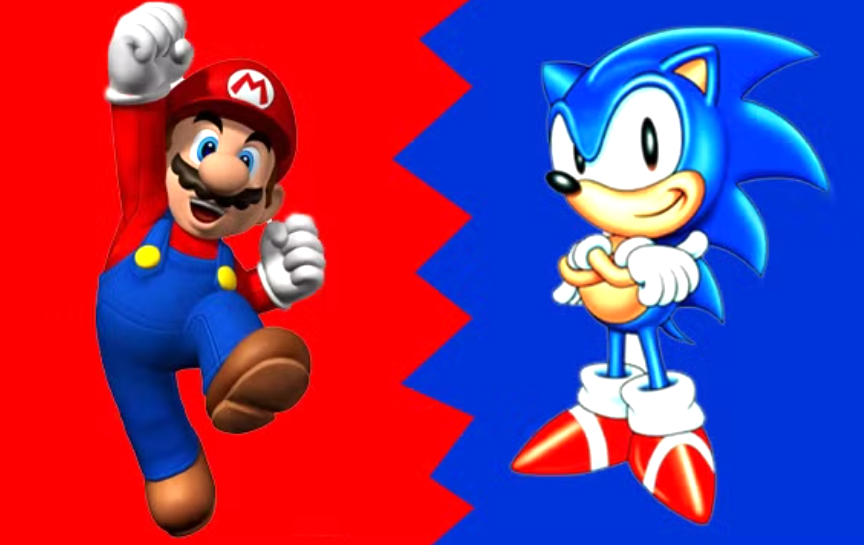
At the center of the console war was a battle of mascots. Nintendo had Mario — a cheerful Italian plumber whose games emphasized exploration, discovery, and precision. Sega's answer, launched in 1991, was Sonic the Hedgehog: a spiky blue attitude machine who ran at blistering speed and had an impatient finger-tap animation when left idle too long. Sonic was a deliberate design statement. Where Mario was friendly and accessible, Sonic was fast, cool, and slightly confrontational — designed to appeal to the older kids and teenagers Sega was targeting. Sonic sold 15 million copies on the Genesis and became the console's defining identity. The rivalry between the two characters mirrored the broader brand war almost perfectly: methodical depth versus kinetic speed, family-friendly versus attitude-driven.
THE BLAST PROCESSING MYTH
Perhaps no moment better illustrates the Console Wars' marketing theater than "Blast Processing." In 1993 Sega commercials, the Genesis was advertised as featuring "Blast Processing" — a technical capability that supposedly allowed it to render games at speeds the SNES could not match. In reality, "Blast Processing" was not a discrete hardware feature — it was a marketing term Sega coined to describe the Genesis's faster CPU clock speed being leveraged by certain game developers. The SNES had compensating hardware advantages Sega's ads did not mention. But the campaign succeeded: "Blast Processing" became schoolyard fact. The episode is a remarkable document of how technical marketing language shapes consumer perception — and how little accuracy matters when the story is compelling enough.
SEGA'S RISE AND FALL
At the Console Wars' peak in 1992–1993, Sega commanded roughly 55% of the North American 16-bit market. But Sega's success planted the seeds of its own undoing. The Sega CD add-on (1992), the 32X add-on (1994), and the Sega Saturn (1995) all launched in rapid succession, confusing retailers and alienating consumers who had invested in the Genesis. When Sony's PlayStation arrived in 1995 with a unified, focused platform and aggressive developer support, Sega had no coherent answer. The console wars Sega had launched against Nintendo ultimately made the industry safe for a third competitor — one that neither Sega nor Nintendo saw coming.
ENTER SONY: THE THIRD PLAYER CHANGES EVERYTHING
When Sony launched the PlayStation in North America in 1995, it didn't just enter the console market — it ended the war between Sega and Nintendo by making both of them fight on a new front simultaneously. The PS1 launched at $299, $100 cheaper than Sega's Saturn, with a CD-ROM drive, an open third-party licensing system, and a marketing strategy aimed squarely at the older teenagers and young adults both Nintendo and Sega had been fighting over. Within two years Sony had overtaken both competitors. By 1999 the PlayStation commanded roughly 70% of the North American market. The console war that Sega had started against Nintendo in 1989 ended not with a winner between those two — but with a third company walking in and taking the trophy while they were still fighting each other.